




Chinese fir plantation at Yangkou State-owned Forest Farm. [Photo/Fujian Daily]
A Chinese research team has revealed how millennia of cultivation and modern breeding have reshaped the genetic structure of Chinese fir, a major timber species in China, in a study published in Nature Communications titled "Genomic insights into the improvement of Chinese fir from ancient domestication continuum to modern breeding."
Researchers from Nanjing Forestry University, Nanjing University, the Fujian Academy of Forestry, and Yangkou State-owned Forest Farm have produced the first chromosome-level reference genome of Chinese fir and developed a liquid breeding chip containing more than 50,000 genetic markers to support the species' genetic improvement.
The team analyzed genome data from 87 Chinese fir samples collected from different regions and 15 ancient trees, including specimens planted in 1176. The study identified three major genetic groups associated with different geographic regions, including the Yangtze River basin, the Wuyi-Nanling region and areas along historical Hakka migration routes.
Researchers found extensive genetic connections among populations, with the Wuyi Mountains likely serving as a historical hub for germplasm exchange and genetic connectivity.
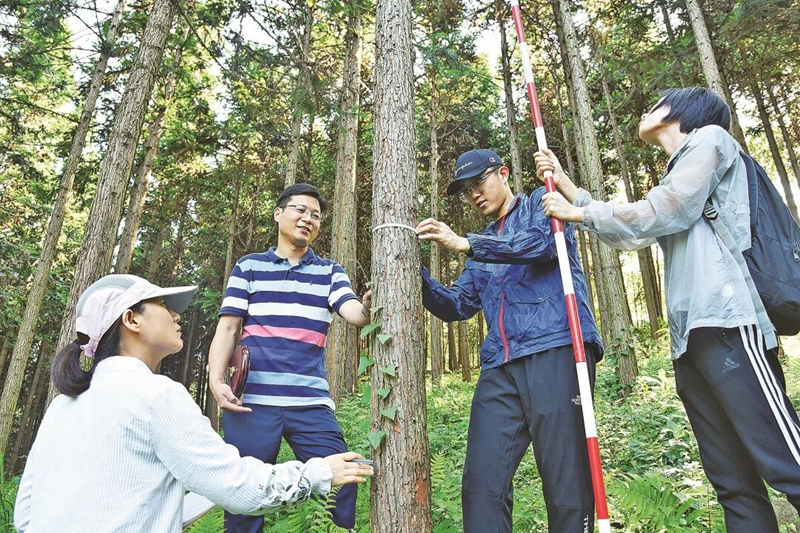
Researchers conduct studies in a Chinese fir experimental forest at Yangkou State-owned Forest Farm. [Photo/Fujian Daily]
The study also found that modern breeding has favored certain genetic lineages, while others, including those represented by many ancient trees, remain underutilized. The researchers said that expanding the use of diverse genetic resources could support future breeding and conservation efforts.

Copyright © General Office of Fujian Provincial People's Government
Website Identification Code 3500000049Registration Number: 15003084
All rights reserved. The content (including but not limited to text, photo, multimedia information, etc) published in this site belongs to fujian.gov.cn.
Without written authorization from fujian.gov.cn, such content shall not be republished or used in any form.
