



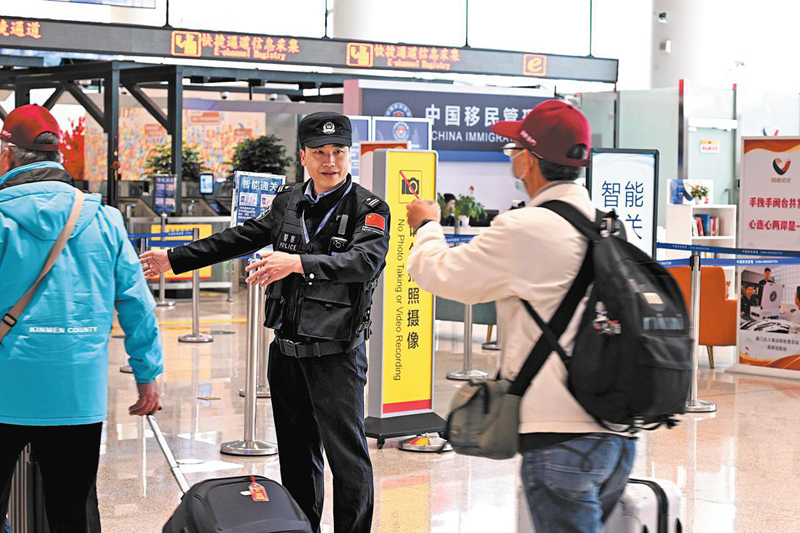
An immigration officer helps a group of Guan Yu Temple pilgrims from Taiwan enter the mainland in Xiamen, Fujian. [Photo provided to CHINA DAILY]
China's recently approved 15th Five-Year Plan (2026-30) has outlined a historic blueprint for integration across the Taiwan Strait, aiming to create a more seamless connection between Fujian province and neighboring islands.
For Chang Yang-yang, a Traditional Chinese Medicine physician at Xiamen Chang Gung Hospital, his journey between his workplace and his hometown on the island of Jinmen is no longer an arduous task but a simple daily commute.
The crossing, which used to take over an hour when Chang was a boy, now takes around 20 minutes, and is representative of the development and integration between the Chinese mainland and the Taiwan-administered islands of Jinmen and Matsu.
Human face of integration
Jinmen sits about 2 kilometers off the coast of Fujian province in East China, at the closest.
Chang said he regularly takes his young son back to his hometown on Jinmen on weekends to visit his grandparents.
"I also often return to my hometown on Jinmen to provide free medical services," he said.
Direct ferry passenger services between the Chinese mainland and the islands began on Jan 2, 2001.
Chang said the route has been upgraded over the years, from requiring stamps in paper booklets to using facial recognition.
"The convenience has been improving step by step over time and is in a state of constant progress," he said.
The integration between Fujian province and Jinmen and Matsu has evolved from simple transport links into an institutional, economic, and physical alignment.
Growing up in Jinmen, Chang said he'd witnessed the long-standing medical challenges faced by his fellow islanders, particularly regarding serious illnesses.
"In my childhood, medical resources on the island were extremely limited," he said.
When residents faced emergencies or critical illnesses, they often had no choice but to endure long and arduous journeys to the main island of Taiwan for treatment.
It was this observation of the difficulty in seeking medical care that drove Chang to cross the Strait to study medicine at Xiamen University and find a way to better serve his community.
Institutional alignment
Chang is part of a growing trend of medical professionals seeking opportunities on the Chinese mainland. At the Taiwan-funded Xiamen Chang Gung Hospital's TCM Department, 11 out of 14 physicians are from Taiwan, accounting for 80 percent of the staff.
Kuo Tzu-chia, the department's executive director, who is also from Taiwan, said many Taiwan physicians choose Xiamen because of cultural affinity and professional opportunities. "Traditional Chinese medicine on both sides of the Strait comes from the same roots," Kuo said.
She noted an increasing number of patients are now traveling from the main island of Taiwan, as well as Jinmen and Matsu, to seek medical treatments in Xiamen.
This trend has been driven by the fact that healthcare services in Xiamen have become increasingly accessible for Taiwan compatriots. "Fujian has benefited from pilot programs that make it more convenient for us to practice medicine on the mainland," Kuo added.
"Looking to the future, we hope both sides can better address healthcare needs and enable mutual recognition of medical insurance reimbursement," she said. "This could ease the burden on fellow patients seeking treatment.
"We also look forward to aligning and mutually recognizing standards for TCM, including technical standards and quality control regulations," Kuo said. "This would allow medical reports to be recognized on both sides, realizing the goal of one test for both sides."
Economic synergy
The integration is also extending into the business sector. Wu Chiaying, vice-president of the Association of Taiwan Investment Enterprises on the Mainland, said he's seen his Fabulous Group in Xiamen diversify extensively.
"Our businesses span multiple industries, including IT, construction materials, food and catering," Wu said. "I was struck by how thoughtful the government policies are, far beyond what I had expected."
Wu said that fundraising was once the biggest challenge for Taiwan enterprises. However, from 2020, the Chinese government has encouraged high-quality Taiwan-funded enterprises to list on mainland stock markets.
"This was a major breakthrough. It allowed Taiwan-funded enterprises to raise funds in the capital market, allowing their businesses to grow bigger and stronger," Wu added.
According to the Taiwan Affairs Office of the State Council, as of January last year, a total of 65 Taiwan-funded enterprises had been listed in the Chinese mainland.
Strategic blueprint
The foundations for these policies were laid decades ago, according to Su Meixiang, a research fellow at the Fujian Academy of Social Sciences. He said that during President Xi Jinping's work as a senior official in Fujian, he pioneered the province's first reception day for Taiwan compatriots.
"He set up the province's first reception day for Taiwan business people and compatriots to understand their needs and help solve their problems," Su added.
Wu, the businessman, said that Xi would meet with Taiwan compatriots from time to time and visit their factories to see how things were going. "He has consistently paid close attention to the development of Taiwan business people on the mainland," Wu said.
Su said that since 2012, President Xi has made three inspection tours to Fujian, where he has emphasized cross-Strait integration through connectivity, mutual benefit, and emotional bonds.
In March, the outline of the 15th Five-Year Plan further provided top-level design for this mission.
Chen Binhua, spokesman for the State Council Taiwan Affairs Office, said at a recent news conference that the document explicitly aims to build a common market across the Strait and strengthen industrial cooperation. Efforts will be made to deepen cooperation in fields such as education and healthcare, and promote the sharing of social security and public resources across the Strait.
The plan highlights the importance of supporting Taiwan enterprises to participate in major regional development strategies and encourages eligible Taiwan-funded enterprises to list on the mainland.
National rejuvenation
As Chang, the TCM doctor from Jinmen, looks out from the ferry during his frequent cross-Strait trips, he sees the future taking shape: the Xiamen-Jinmen Bridge, with towers shaped like the Chinese character for "gate". The major part of the Xiamen section of the bridge is scheduled to be finished this year.
Chang noted a critical detail that addresses the challenges he saw in his youth. "The bridge will include emergency lanes for ambulances to facilitate their swift passage," he said.
"In the future, Jinmen residents could go straight to Xiamen for surgery. This would be a significant benefit," he said, emphasizing that this is perhaps the greatest benefit for the welfare of the people of Jinmen.
Su, the researcher, added that the bridge will be part of an integrated network, including shared use of Xiamen's new international airport and connected power grids to address electricity shortages on Jinmen.
"This kind of cross-regional infrastructure connects not just the land, but also the shared development destiny of both sides," Su said.
For Wu, this represents the ultimate goal: "We are one family. Cross-Strait integration is a crucial part of laying the foundation for the great rejuvenation of the Chinese nation."
Su said as Fujian accelerates the connection between the two sides, the shallow Strait described by late Taiwan poet Yu Guangzhong (1928-2017) decades ago is no longer a symbol of "inescapable nostalgia".
As President Xi once said, Chinese people on both sides of the Taiwan Strait have always been one family; they should often interact with each other, which will bring them closer and promote their kinship.

Copyright © General Office of Fujian Provincial People's Government
Website Identification Code 3500000049Registration Number: 15003084
All rights reserved. The content (including but not limited to text, photo, multimedia information, etc) published in this site belongs to fujian.gov.cn.
Without written authorization from fujian.gov.cn, such content shall not be republished or used in any form.
