



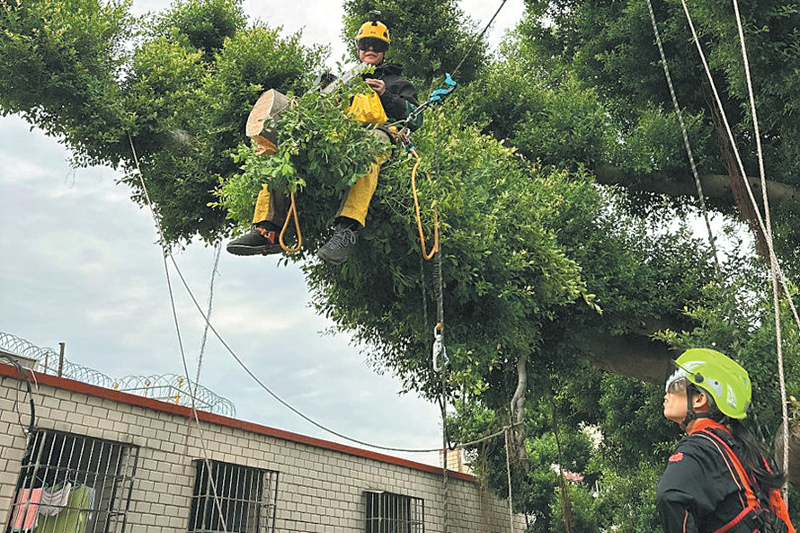
Yu Yanling (right) watches her colleague working on a branch in Xiamen, Fujian province. CHINA DAILY
Before the howling wind and heavy rainfall brought on by typhoons sweep into Xiamen, Fujian province, Yu Yanling goes to work. While others seek shelter, the 34-year-old straps on a harness, checks her ropes, and ascends into the chaos of the canopy.
She is a professional arborist, certified by the International Society of Arboriculture, and is among a small group of people doing this work across the country.
Her job is part tree surgeon, part urban protector. She works with major parks and botanical gardens. During typhoon season, her busiest time of year, Yu spends entire days hanging in the canopy, trimming branches so trees and the people below can ride out the storm safely.
Sometimes she assists researchers, climbing into dense branches to gently retrieve chicks, fit them with trackers, and return them to their nests.
And occasionally, she helps tourists retrieve drones stuck in treetops.
Her team is often called in for jobs that standard equipment, like bucket trucks or pole saws, simply can't handle.
"Tree trimmers with a bucket truck can finish a job in just half a day, whereas it takes us a full day or two," Yu said. "If a tree can be trimmed using a bucket truck, they don't hire us. We only get called in for the extremely difficult cases."
Yu further elaborated on the challenges faced when dealing with complex tree issues. "When a tree has diseased tissue deep within its crown, tree trimmers using a bucket truck — often equipped with a hydraulic extendable boom and an aerial work platform — can only prune from the outside in. This means that healthy outer branches must be removed first, just to reach the problem areas.
Trimmers often end up snapping branches simply for access, turning what should be a targeted removal into an unnecessary amputation of entire limbs.
"Arborists like us, on the other hand, can work from within, moving with precision and treating the tree on its own terms," she said.
After a typhoon hit Xiamen in 2016, Yu and her university team were mobilized to help clear damaged trees.
"The typhoon damaged over a million trees, leaving branches scattered across the ground and blocking vehicles," she said.
"I was about to graduate when our tree-climbing lecturer took us out to help. The damage varied greatly from tree to tree. Some branches had snapped and were lodged in other trees or tangled within their own branches, requiring us to climb up to remove them."
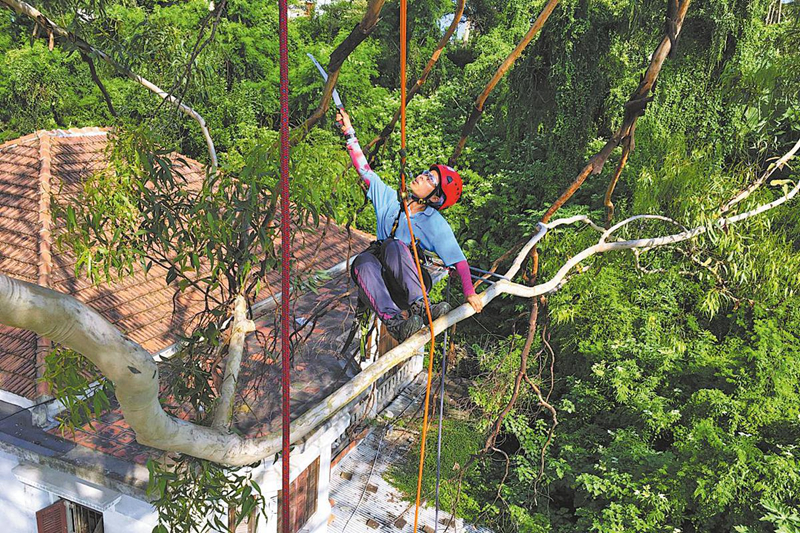
Yu trims a diseased branch on the canopy of a tree in Xiamen. CHINA DAILY
Safety protocols
Despite her 10-year climbing experience, Yu remains fully aware of the risks involved.
"When I get high up, my legs sometimes shake. But when I'm up that high, 20 meters or higher, taking big swings, there's simply no time to dwell on it because tree work carries risks.
"For recreational climbing, it's great exercise and not likely to hurt climbers. But with tree work, injuries can happen," Yu said.
To mitigate the risk of injury, Yu always seeks out a secure position, a spot to stand in order to make the cut safely.
"When I cut a branch, I always check first. Sometimes two branches are intertwined, pressing against each other. If I don't see that and just cut, a branch can snap back and hit me in the face or neck. That can be fatal," she said, adding that an arborist needs strong spatial awareness and an ability to predict how things will move.
She added: "One can have experience with similar situations, but no two trees are exactly the same. We need to rely on accumulated practice to develop a sense of what's going to happen. The closer the prediction matches reality, the safer we are."
The difference in approach has consequences. Yu uses an analogy to describe what happens when untrained workers prune a tree: "If a finger is injured, professionals might only need to amputate the finger. But some untrained ones take the whole arm. The bad branch is gone, but what's left behind is a mess."
She explained that a trained arborist knows where and how to make a cut so the tree can activate its own healing mechanisms. The wound forms a protective callus, sealing out bacteria and decay.
Skill honing
Yu's path into the profession began on a university campus. In 2015, Yu was a third-year student at Xiamen University, a school known for its lush growth of big trees. She tried a tree-climbing class one day and decided to stick with it.
She had participated in sports from a young age, so the physical demands of climbing came easily to her. "I picked it up very quickly," she said.
A trip to a competition in Hong Kong at the end of 2015 changed her understanding of the field. "What I learned in school were the basic things. In Hong Kong I saw many techniques, with more specialized gear and equipment. I never imagined people could make a career out of this. And I found it fascinating," she said.
In the years that followed, she used her own money to travel to Hong Kong and Taiwan for training and exchanges.
Seeing their daughter working in the sun and wind, doing something dangerous and physically demanding, Yu's parents kept on reminding her to take the civil service exam.
But something kept her in the trees. As a student, she had struggled with social interaction.
"I would get very tangled up about what facial expression to use, how to handle a situation, what mood to project, how to make others feel," Yu said.
In the trees, she found something different. "When I'm up there, I'm alone. But I feel surrounded by things full of life. It makes me relax. The trees have healed me," she said. "And with the skills I've learned, I can give them a different kind of treatment, help them stay healthier, help their wounds heal faster."
Yu doesn't work alone in the canopy. A chance encounter brought her a partner who shares her passion for the work.
Wu Mina was running a guesthouse on the island of Gulangyu in Xiamen when a chance sighting in 2016 changed his life. He spotted a young woman suspended high in a lemon-scented gum tree, trimming branches with calm precision, while a man on the ground assisted her.
"I was stunned that someone so slight could be up there so safely," the 55-year-old said.
"I thought, if only I could do something that interesting."
The woman in the tree was Yu. She became Wu's teacher in 2021. Since then, Yu has called on him whenever she has tree work.
For Wu, tree work is a discipline built on meticulous safety. "When a climber is aloft, I become her eyes from below. Climbers lose certain angles; they can't always see what is coming," Wu said.
"Every branch cut must be lowered with ropes to control its descent. Make sure it stays clear of buildings, power lines, and any delicate plants."
The safety checks begin long before anyone leaves the ground. "We assess the whole environment. Is the tree hollow? Has it been chewed by insects or animals? Are there beehives, ant nests or power lines running through the crown?" Wu said.
Once a line is set, the team loads it with twice a person's body weight. "If it holds the weight of two people, we can trust it," Yu said.
One rule is absolute: nobody works alone, Yu said. In a profession where anything from weather events to wildlife can turn a routine job into an emergency, the buddy system is not optional.
"Suppose an arborist working on a tree is stung by bees, bitten by a snake, suffers heatstroke or even cuts themselves with a saw and can't get down. The second person has to be able to climb up, reach them and bring them safely to the ground," Wu said.
What keeps Wu climbing, however, is not just the discipline involved but the unpredictability. "Every tree job is different. Even if I climb the same tree twice, the task, the route, the methods can all change. There's so much uncertainty and I approach each one with a fresh perspective," Wu said.
Far from finding it stressful, Wu said this is the source of the work's joy. "If I had to repeat the same thing over and over, like so many jobs, I wouldn't be happy. The challenge, the unknown is what makes it satisfying," Wu said.

Copyright © General Office of Fujian Provincial People's Government
Website Identification Code 3500000049Registration Number: 15003084
All rights reserved. The content (including but not limited to text, photo, multimedia information, etc) published in this site belongs to fujian.gov.cn.
Without written authorization from fujian.gov.cn, such content shall not be republished or used in any form.
