



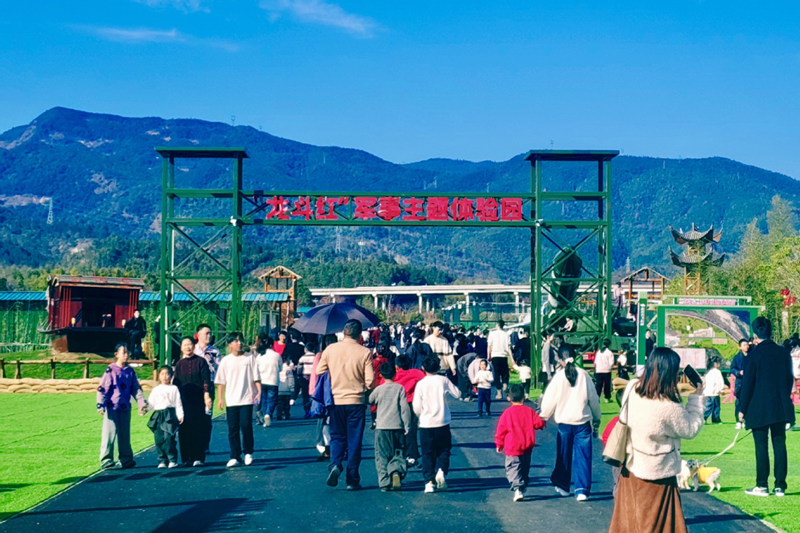
Visitors flock to the Longdou scenic spot in Shaowu, Fujian province, which merges revolutionary history and contemporary fun during the Spring Festival holiday.[Photo provided to China Daily]
At 4 am, while most of Shaowu in northern Fujian province is still asleep, steam rises from Cai Minjun's shop. Inside, a dozen women sit around long tables in the fluorescent-lit workspace, pinching, folding, and sealing to transform lumps of dark-speckled rice dough into crescent-shaped dumplings.
Each gets a distinctive crimped pattern before being arranged on pine needles in bamboo steamers. In addition to this local specialty, more than 60 cultural and tourism events in Shaowu have spanned the holiday period, including cycling tours along local classic mountain trails, street fairs selling traditional New Year goods, and cultural souvenirs. Calligraphers are invited to write spring couplets and the character for "fortune" (fu) for shoppers, according to local authorities. The events run from early February through March, covering both Spring Festival and Lantern Festival, says Wang Zhenhua, director of the city's industry and information bureau. The goal is for everyone to spend the Chinese New Year in a joyful and peaceful atmosphere.
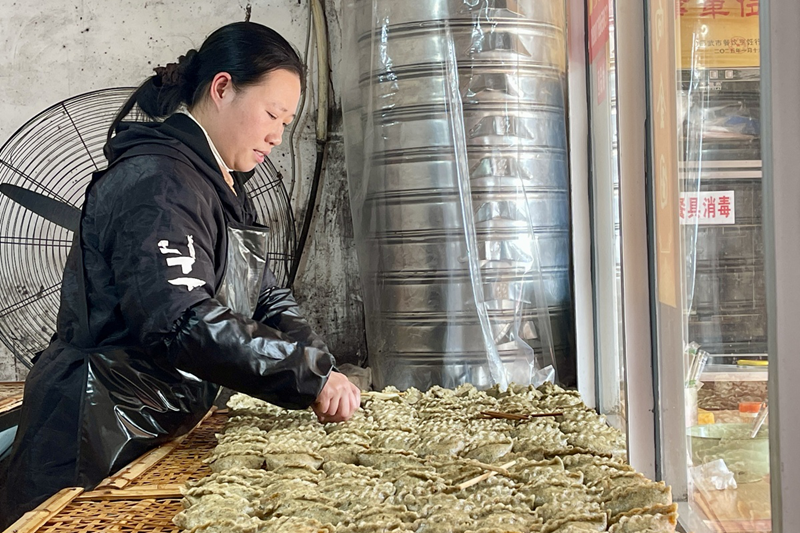
An employee arranges baoci in Cai Minjun's shop in Shaowu.[Photo by Yang Feiyue/China Daily]
Generations of dumplings
By 6 am, Cai's first batch of dumplings is ready for hungry customers. "Business peaks around the Spring Festival holiday," Cai says, adding that the specialty carries both culinary appeal and deep sentimental value for locals who grew up eating it. "We hit 14,000 pieces on our best days — and even have to turn customers away," Cai says, a note of pride mixed with exhaustion in his voice. Cai, 37, is a third-generation maker of baoci, a Shaowu specialty. He took up his parents' trade about a decade ago. "There's definitely a learning process. Many people from Shaowu can make them. But the difference between edible and excellent is in the details. How chewy is the skin? Is the filling balanced?" he explains. "My parents taught me bit by bit, and I kept practicing. After all, they'd been doing it for years," he says. To understand baoci, one has to understand the geography of Shaowu, where narrow mountain paths historically connected villages and local cuisine evolved from nearby ingredients, including rice from terraced paddies, bamboo shoots from mountain groves, and mushrooms from damp forest floors. Baoci is the edible expression of this landscape.
The wrapper starts with local rice, soaked overnight, then boiled until it reaches the exact tenderness. "A minute more or less in the pot changes everything," Cai explains. "The texture, the chewiness — it's all about timing." A local wild plant called shuiqucao is then added, which gives the dough its characteristic dark green flecks. The filling is a medley of mountain and field: mushrooms, bamboo shoots, firm tofu, smoked pork, dried cuttlefish, and shredded turnip. Each ingredient is stir-fried separately before being combined, allowing each flavor to maintain its identity. His parents started selling baoci in nearby Yanshan town in 2003, when city residents would take the bus to the town or ask drivers to bring back packages. By 2017, the family decided to move the shop to Shaowu proper. In the back of Cai's shop, a team of women has been working away to keep up with the demand. "They're all from Yanshan. The youngest is in her 30s, while the oldest is pushing 70," he says.
Each finished baoci bears the distinctive ridges that mark it as Yanshan-style, as opposed to the smoother version from neighboring Heping town.
"The pattern isn't just for looks. It seals the opening so they don't burst while they are steamed," he explains.
From late December through the festival, Cai's shop produces between 8,000 and 10,000 pieces daily.
Morning customers are locals grabbing breakfast or lunch. Midday brings people preparing for gatherings. The rest of the day is left to shipping orders.
"Eighty to 90 percent of our shipped orders go to Shaowu people living elsewhere," Cai says.
"They send them to Beijing, Hainan province, and as far as Xinjiang Uygur autonomous region," he adds.
"People clearly want the taste of home," Cai says.
Baoci is just one taste of Shaowu welcoming the Chinese New Year. Across the city, authorities have rolled out a full slate of events blending culture, tourism, and commerce.
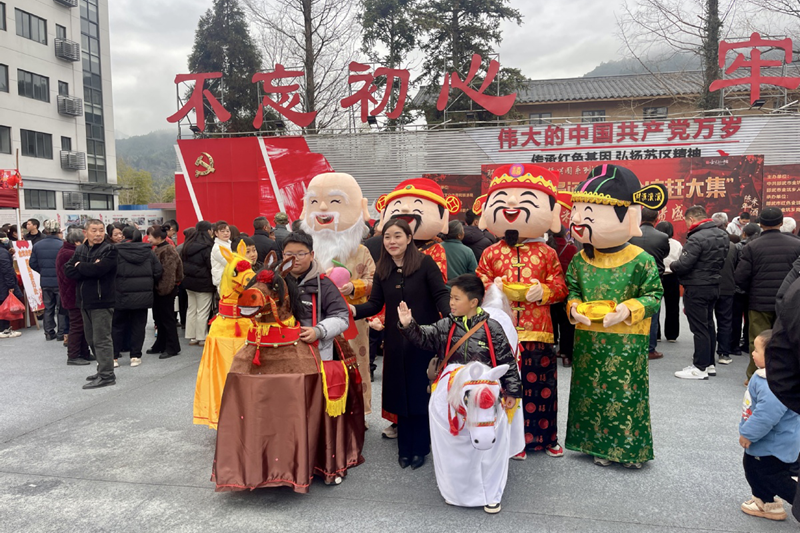
Visitors pose for photos with performers dressed as auspicious figures during the rice wine competition in Jinkeng village, Shaowu.[Photo by Yang Feiyue/China Daily]
Mixing sweet with strong
In Jinkeng village, an hour's drive from the city, the smell of rice wine fills its central public square at the beginning of the holiday.
Village chief Tu Yuyuan stands before a row of newly unsealed clay jars, kicking off the annual Jinkeng rice wine opening ceremony.
Deng Chuanju, 48, didn't expect to win this year's Wine King competition.
"I never thought my family's wine was special. Other families make good wine, too. But everyone said ours was the best. I'm happy," he says.
His wine is made by his mother, in her 60s, using a recipe passed down from her mother. She makes it every year around the winter solstice, when the weather turns cold.
The wine is made from steamed sticky rice cooled to the right temperature, mixed with a starter culture, and then left to ferment. That's it. The rest depends on experience and luck.
"Temperature matters. Too hot, and the wine spoils. Made around the winter solstice, it just gets purer as it sits," he adds.
His family's signature is sweetness.
"People who don't drink much like it sweet. Heavy drinkers prefer it stronger. Ours hits the middle, as it is sweet enough for the first sip to taste good, but with enough kick," he elaborates.
From 100 jin (50 kilograms) of rice, they get about 60 jin of wine. They make seven or eight batches a year, selling at 15 yuan ($2.17) per jin. By Spring Festival, it's usually sold out.
In Jinkeng, locals affectionately call the rice wine "Red Army Cola".
"This is an old revolutionary base area," explains Deng Chuanzhan, head of the local chamber of commerce.
"The Red Army passed through here. Rice wine is one of our three famous products, along with dried fish and wild mushrooms."
He ordered 600 jin this year to give as gifts to friends in Xiamen and Fuzhou, the provincial capital.
"The packaging is getting nicer," he notes, adding that it is perfect for visiting friends and family during the festival.
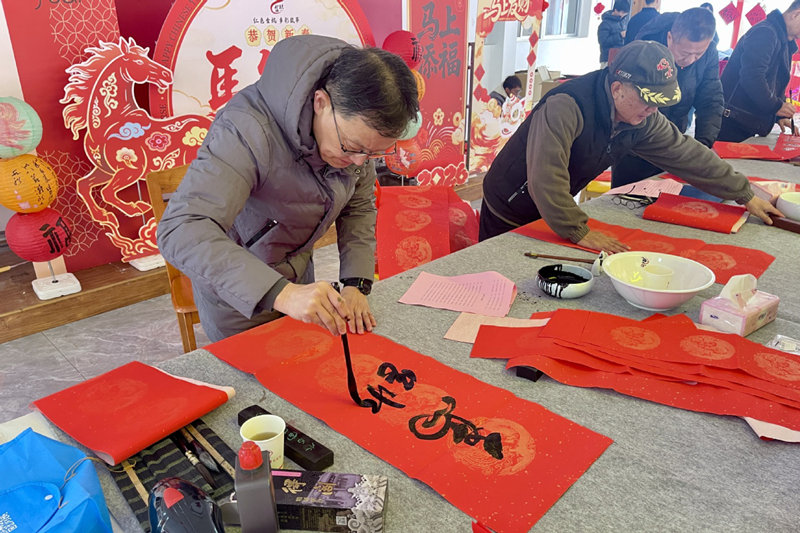
Artists are invited to write Spring Festival couplets for local residents.[Photo by Yang Feiyue/China Daily]
Behind the masks
Back downtown, Nie Xuequn and her troupe have been revving up to give traditional nuo dance performances, one after another throughout the festival.
They came up with an innovation this year and rehearsed for a month.
Audiences applaud as she bites down on a mask and takes a breath through her nose.
The mask is made of paper, hand-painted with colorful patterns. It's smaller and less fearsome than the wooden ones her ancestors wore. A small stick inside lets her hold it in her mouth while dancing, freeing her hands for movement.
"It makes my mouth sore, and breathing is harder too," she admits, adding that old masks had nose and mouth holes and the new ones only have eye openings.
Nie is an inheritor of nuo dance, a ritual performance that dates back more than 1,000 years in rural China. Originally, it was a form of exorcism, featuring masked dancers who jumped and shouted to drive away evil spirits and pray for good harvests.
"People relied on this method back when medicine and science weren't developed," Nie explains.
"They'd dance to ward off sickness, to ask for peace and prosperity."
Today, they have made adjustments to meet modern preferences.
"The masks can't be too fierce, so we made them cuter, more acceptable to contemporary audiences," she says.
They also ditched the heavy wooden masks and props to free their limbs for jumps, spins, and dramatic head turns in line with the newly added dynamic music.
Her troupe of 18 dancers, the oldest 50 and the youngest just 18, has performed at Shaowu's high-profile events, including those attended by city leaders and retired officials.
"Audiences have given us great feedback and actively responded to our invitation to try the nuo dance on stage," Nie observes.
"Anyone can do it. It came from farmers and villagers. It's for everyone."

Copyright © General Office of Fujian Provincial People's Government
Website Identification Code 3500000049Registration Number: 15003084
All rights reserved. The content (including but not limited to text, photo, multimedia information, etc) published in this site belongs to fujian.gov.cn.
Without written authorization from fujian.gov.cn, such content shall not be republished or used in any form.
