



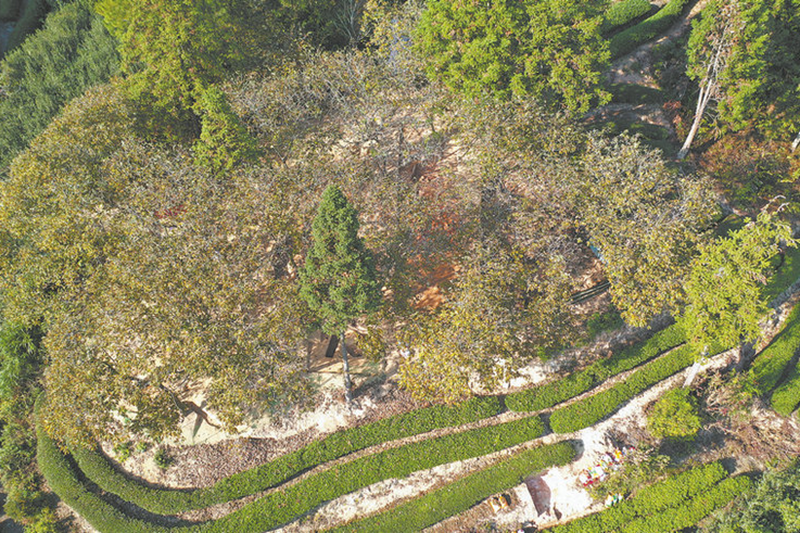
A panoramic view of the Kiln No 1 site at Zhulinkeng, nestled on a hillside in Fujian's Mount Wuyi. [Photo provided to China Daily]
On a hillside in Fujian province's Mount Wuyi, the grass still grows over two dark-red scars in the earth. They are all that remain of a fire that burned out 3,000 years ago. But what that fire produced and where those products ended up, archaeologists say, have rewritten a chapter of Chinese ceramic history.
This is the only known kiln site in China from the early-to-middle Western Zhou period (c. 11th century-771 BC), and the best-preserved "living fossil" of proto-porcelain production from the pre-Qin era (before 221 BC).
Proto-porcelain is the precursor to mature porcelain. Fired at temperatures above 1,100 C, hundreds of degrees hotter than ordinary pottery, it was coated with a glassy glaze. Differences in raw materials and firing stability set it apart from true porcelain, experts explain.
For decades, the chronological sequence of proto-porcelain in China contained a puzzling gap. More than 100 pre-Qin kiln sites have been discovered across the country, concentrated mainly in the north of East China's Zhejiang province, spanning the Xia (c. 21st century-16th century BC) and Shang (c. 16th century-11th century BC) dynasties, the late Western Zhou, and the Spring and Autumn (770-476 BC) and Warring States (475-221 BC) periods.
But the early-to-middle Western Zhou, a crucial three-century period around 3,000 years ago, remained a blank spot.
"It was as if a complete history of ceramics was missing its central chapter," says Zheng Jianming, a professor of archaeology at the Shanghai-based Fudan University.
The gap also fueled a long-running academic debate: did proto-porcelain originate in northern or southern China?
That missing chapter has now been found in the bamboo-shaded hills of Mount Wuyi. In 2025, archaeologists launched a new excavation of Kiln No 1 at the Zhulinkeng site. Radiocarbon dating confirmed the kilns were active around 3,000 years ago, squarely in the early-to-middle Western Zhou period.
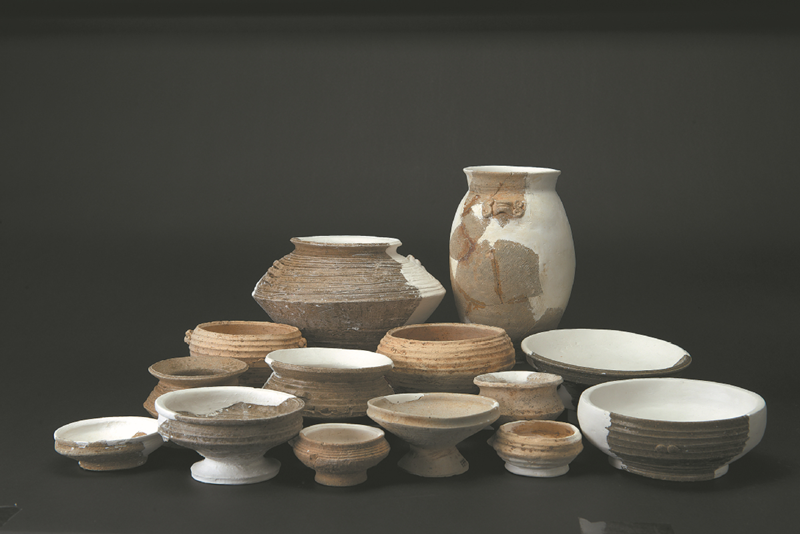
Selected proto-porcelain vessels unearthed from Kiln No 1 at Zhulinkeng, featuring thin blue-green glazes and delicate crackle patterns. [Photo provided to China Daily]
Pottery takes a leap
Tests conducted by a team from the Jiangsu province-based Nanjing University on samples from the Zhulinkeng kiln complex measured firing temperatures of approximately 1,220 C for the proto-porcelain and 1,190 C for the stamped hard pottery found alongside it.
The figures matter because ordinary earthenware is typically fired at only 700-800 C. Crossing the threshold to 1,100 and above represents a qualitative leap.
"From pottery to proto-porcelain was a true technological revolution in the history of porcelain," says Yang Zelin, deputy director of the Fujian Provincial Institute of Archaeology and lead archaeologist of the excavation.
Even more striking was what the analysis revealed about material selection. According to the archaeological team, potters at Zhulinkeng deliberately adjusted their clay recipes to suit different types of vessels.
For larger containers, such as jars, they increased the alumina content to prevent warping. For smaller pieces, including stemmed bowls, they used a more plastic clay.
Experts say this reflects a sophisticated understanding of material properties. Different kilns within the complex also produced distinct wares, with variations in glaze and firing techniques.
Some kilns specialized in high-quality products, while others focused on more ordinary products, notes Li Zequn, an archaeologist at Nanjing University.
Such standardization points to a remarkably high degree of specialization, Li adds.
One of the most distinctive features of Zhulinkeng's wares is their thick walls and thin glaze.
Yang explains that this was a deliberate choice, unrelated to firing temperature. Instead, it reflected the glazing process and the glaze's chemical composition.
Zhulinkeng's potters chose a fluid glaze that spreads thinly and evenly, producing a distinctive blue-green surface marked by fine crackles, he says.
A century of innovation
The evolution of the kilns themselves tells an equally compelling story. Excavations have uncovered four cave-style dragon kilns from this period. Two of them, designated IY4 and IY1, are particularly well-preserved and illustrate a rapid technological advance.
IY4, the older kiln, is a 7.8-meter tunnel with a firebox at one end and a small exhaust vent at the rear. Flames rose directly into the chamber with no guidance. IY1, nearly two meters longer, introduced two innovations: twin flues that accelerate flames through the Venturi effect, and a larger fan-shaped exhaust vent.
"The larger the exhaust vent, the stronger the updraft," Yang says.
The combined effect was transformative: more intense fire, higher temperatures, and the ability to fire larger batches of vessels. Archaeologists estimate that the upgrade occurred in less than a century.
"This represents very rapid innovation," Yang says.
Another remarkable aspect of kilns in Zhulinkeng is the state of preservation, as most contemporary kilns elsewhere in China survive only as truncated floors, their walls and roofs long since collapsed.
The answer lies in how they were built. Contemporary kilns in Zhejiang were semi-subterranean — a shallow trench perhaps 20 to 30 centimeters deep with a vaulted superstructure above ground.
"Like a vegetable greenhouse, the upper part was vulnerable. Over thousands of years, it crumbled," Yang explains.
Zhulinkeng's kilns, by contrast, are fully subterranean, cut deep into the hillside, and arched like cave dwellings.
"They lie at least half a meter below the modern ground surface," Yang describes, adding that even if farming disturbs the topsoil, the main structure remains intact.
The trade-off was enormous labor. Digging tunnels several meters long using primitive tools and manual effort was no small task.
"It was a monumental project, and because the builders chose the harder path, today we can see a nearly intact 3,000-year-old kiln," Yang says.
Around the kilns, the excavation team uncovered a full production complex: clay storage areas, washing pools, drainage ditches, shaping floors, drying platforms, and piles of discarded wasters — vessels that cracked or warped during firing.
"This was a purpose-built, highly organized, specialized production facility," Yang says.
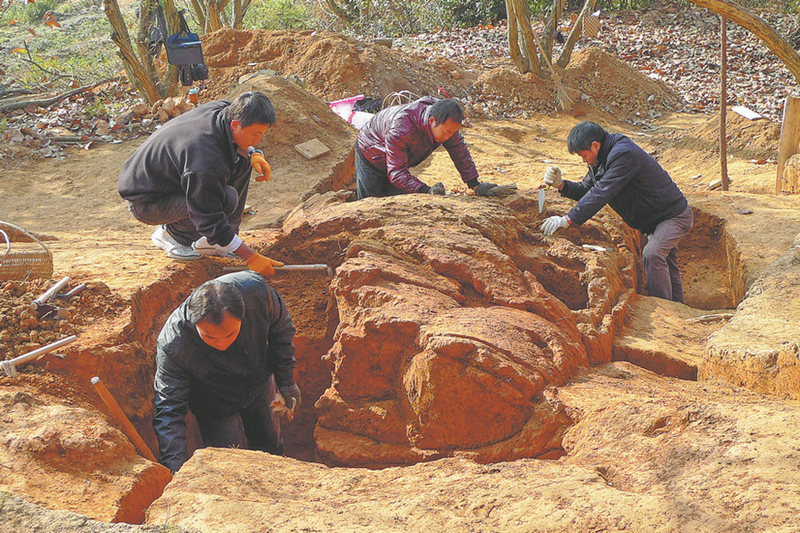
Archaeologists excavate and clean Kiln No 1. [Photo provided to China Daily]
Controlling the flames
Across northern Fujian, archaeologists have found high-status tombs from the same period — large earthen burial mounds containing Zhulinkeng proto-porcelain alongside bronze ritual vessels — exclusive markers of elite status during the Western Zhou period.
"These were not ordinary burials. The people interred in them were likely tribal chiefs or nobles, who controlled proto-porcelain production," Yang says.
Maintaining a dedicated industrial zone and supporting a full-time ceramic workforce required substantial resources and social organization, something only elites could provide, he adds.
For decades, archaeologists had unearthed substantial quantities of early Western Zhou proto-porcelain at major northern sites, including Zhouyuan in Shaanxi and Liulihe in Beijing, but could not determine where it had been produced.
The Nanjing University team compared the chemical composition of Zhulinkeng's wares with samples from those northern sites. The match was unmistakable.
"It is like fingerprint analysis. We can now say with confidence that a significant proportion of the early-to-middle Western Zhou proto-porcelain found in northern China was produced at Zhulinkeng," Yang says.
The discovery shows that the kilns of northern Fujian were integrated into supply networks serving the Zhou political center.
In the early Western Zhou, bronze vessels occupied the pinnacle of ritual culture, but bronze was rare and accessible only to the highest nobility. Proto-porcelain — hard, glossy, and capable of being produced on a much larger scale — served as a crucial supplement. The vessels produced at Zhulinkeng closely mirrored the shapes and dimensions of their bronze counterparts used in the Zhou heartland, according to the project's archaeologists.
"Fujian's contribution to pre-Qin civilization has often been overlooked," Yang says. "This discovery shows that, more than 3,000 years ago, the people of northern Fujian built a bridge of cultural exchange between south and north."

Copyright © General Office of Fujian Provincial People's Government
Website Identification Code 3500000049Registration Number: 15003084
All rights reserved. The content (including but not limited to text, photo, multimedia information, etc) published in this site belongs to fujian.gov.cn.
Without written authorization from fujian.gov.cn, such content shall not be republished or used in any form.
