



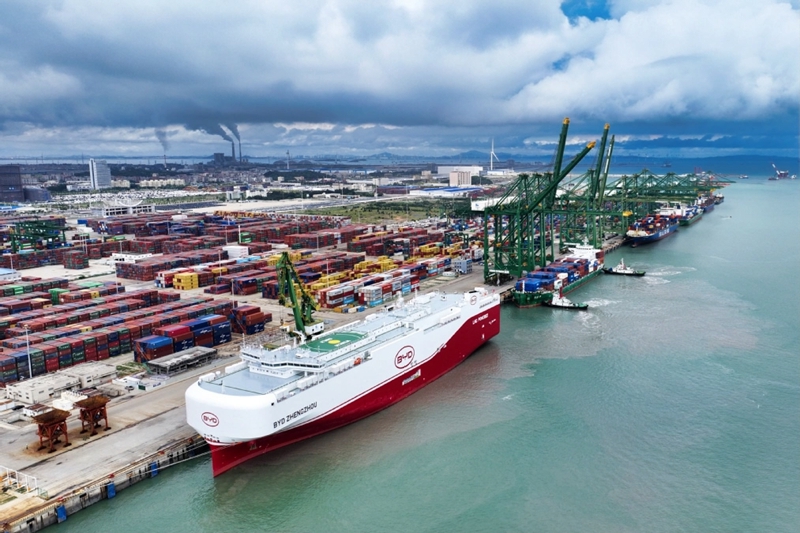
The BYD Zhengzhou, a roll-on/roll-off vessel, sets sail from the Jiangyin port area of Fuzhou Port in Fujian province on Aug 22. [Photo provided to chinadaily.com.cn]
A digital trade platform in Fujian province is helping China better integrate ports, shipping, and trade, as highlighted during the "Water Transport China" multimedia tour organized by the Ministry of Transport.
Since its launch in March, the Silk Road Maritime trade data service platform has compiled information on 3 million product types across 230 countries and regions. The platform aids exporters with market and customer data and assists ports, shipping companies, and logistics operators in analyzing cargo demand and planning services. Its data is also valuable for financial institutions in risk assessment and government departments in industrial planning.
The service aims to overcome data barriers in the maritime trade sector, where information has traditionally been scattered across different systems, making it difficult to track the entire logistics chain. Small and medium-sized exporters have been particularly affected by limited access to market and shipping data.
The platform is part of China's initiative to promote the integrated development of ports, shipping, and trade, a goal set out in the country's 15th Five-Year Plan (2026-30). Silk Road Maritime, launched in Fujian, is an international logistics brand and service platform under the Belt and Road Initiative, which has expanded from building shipping routes to creating a broader digital ecosystem connecting ports, carriers, and trading companies.
A report released during the program gave Fujian an overall score of 92.1 out of 100 for the coordinated development of its port, shipping, and trade sectors. By the end of 2025, Fujian's coastal ports operated more than 310 container routes, including 167 international services connecting over 160 ports in more than 60 countries and regions, with a shipping fleet capacity exceeding 21 million deadweight tons.
Efficiency has improved at major gateways, with the average ship turnaround time at Xiamen Port just 40.4 percent of the global average, while Fuzhou Port ranked first in the World Bank's 2025 Container Port Performance Index. Closer links between maritime and inland transport are extending port services to a wider hinterland, with cargo throughput and sea-rail freight volumes increasing.
Digital technology is also reducing weather-related shipping risks through a meteorological platform monitoring conditions at 58 ports in China and overseas, improving navigation efficiency across major oceans by an average of 30 percent.

Copyright © General Office of Fujian Provincial People's Government
Website Identification Code 3500000049Registration Number: 15003084
All rights reserved. The content (including but not limited to text, photo, multimedia information, etc) published in this site belongs to fujian.gov.cn.
Without written authorization from fujian.gov.cn, such content shall not be republished or used in any form.
