



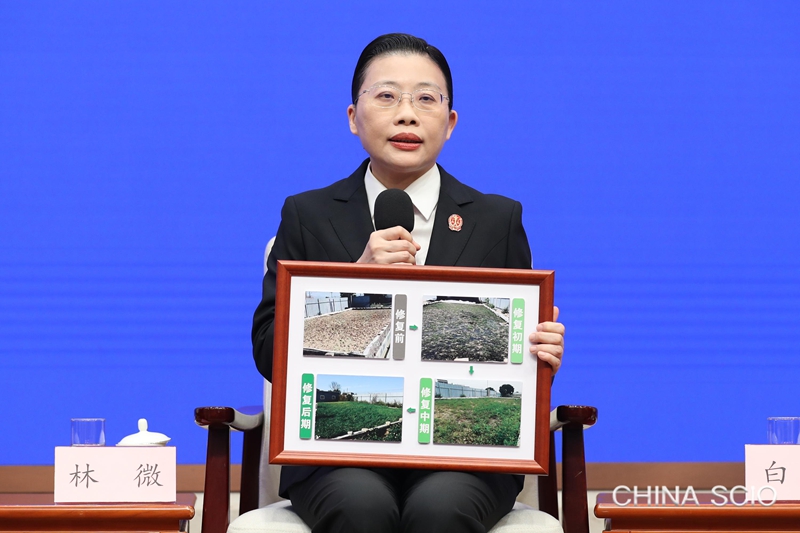
Lin Wei, vice-president of the Zhangzhou Intermediate People's Court, displays before-and-after images of land restored in an environmental pollution case. [Photo by Xu Xiang/China SCIO]
Lin Wei, vice-president of the Zhangzhou Intermediate People's Court in Fujian province, shared her experience in advancing ecological justice at a meeting with Chinese and foreign journalists hosted by the State Council Information Office on Sept 20.
Lin brought a display board showing before-and-after images of land restored in a case involving environmental pollution. The site was barren before restoration and covered with lush vegetation afterward.
The defendant had discharged wastewater containing pollutants into the soil. As conventional restoration would have been costly and beyond the defendant's means, the court, drawing on expert advice, adopted a more economical and feasible approach. It first used a soil-washing technique to remove pollutants and then planted vegetation capable of absorbing them. After two years, the soil's ecological functions were restored at just one-quarter of the conventional restoration cost.
Lin led her team to become the first in China to explore an ecological technical investigator system, bringing ecological experts into cases to help courts quantify environmental damage and develop feasible restoration plans. The team also pioneered a judicial protection and ecological governance mechanism for blue carbon and handled China's largest single case involving the judicial purchase of mangrove carbon credits, with more than 1 million yuan ($149,336.8) in proceeds used entirely to plant mangroves and create greener coastlines near residential communities.
"We adjudicate cases, protect our homes, and give people peace of mind," Lin said.

Copyright © General Office of Fujian Provincial People's Government
Website Identification Code 3500000049Registration Number: 15003084
All rights reserved. The content (including but not limited to text, photo, multimedia information, etc) published in this site belongs to fujian.gov.cn.
Without written authorization from fujian.gov.cn, such content shall not be republished or used in any form.
