



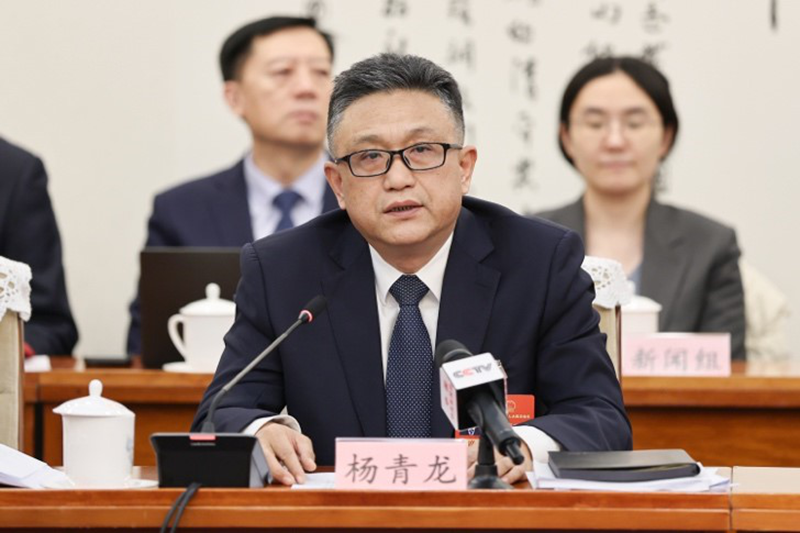
Yang Qinglong, a deputy to the 14th National People's Congress and mayor of Guyuan, Ningxia Hui autonomous region, delivers a speech during the region's open day during two sessions in Beijing on March 6. [Photo provided to chinadaily.com.cn]
In China's once-impoverished Xihaigu region, long known as one of the country's harshest places to live, a story of cooperation between two distant provinces has helped transform barren hills into growing communities.
Yang Qinglong, a deputy to the 14th National People's Congress and mayor of Guyuan, Ningxia Hui autonomous region, said on the sidelines of the ongoing two sessions: "For many families in Xihaigu, the change has been profound. The partnership has helped the region move from one of the most impoverished places under heaven to a land of hope and opportunity."
The cooperation, known as the Fujian-Ningxia pairing program, began in the 1990s as part of China's broader strategy to reduce regional inequality. Fujian province, one of China's more prosperous coastal provinces, was tasked with supporting development in landlocked Ningxia, particularly its mountainous southern region.
Yang said the collaboration combined Ningxia's determination to overcome hardship with Fujian's resources and development experience. Through water diversion projects, irrigation improvements, and water-saving technologies, authorities were able to ease the region's long-standing water shortages — a fundamental barrier to both survival and economic growth.
The partnership also helped bridge geographic and ethnic divides through two-way assistance, resettlement programs, and cultural exchange.
"What we have seen is not just economic support," Yang said. "It has been a process of integration — in industry, in culture, and in people's lives."
The cooperation gradually expanded from basic livelihood improvements — such as drinking water, roads and housing — to broader economic, ecological and cultural development.
According to Yang, the program has fundamentally changed the way more than one million residents in Ningxia live and work.
Fujian and Ningxia have jointly built 12 industrial parks under the program, combining Fujian's capital and markets with Ningxia's land and resources. The arrangement has fostered closer integration across supply chains, industrial chains, and service networks.
Yang said the partnership has driven three key shifts in local livelihoods: from direct financial aid to industrial investment, from manual labor to skilled employment, and from migrant work to entrepreneurship back home.
In Guyuan alone, Fujian has invested nearly 2.8 billion yuan ($390 million) over the past three decades, funding more than 800 projects.
The effort helped lift about 450,000 people out of poverty and relocate 840,000 residents from environmentally fragile areas. Over the same period, the city's economic output expanded 33-fold while rural residents' per-capita disposable income increased 22 times.
Today, nearly 50,000 people from Ningxia live and work in Fujian, building businesses, starting families, and settling down. In Ningxia, the grandchildren of the earliest Fujian migrants now speak fluent local dialect.
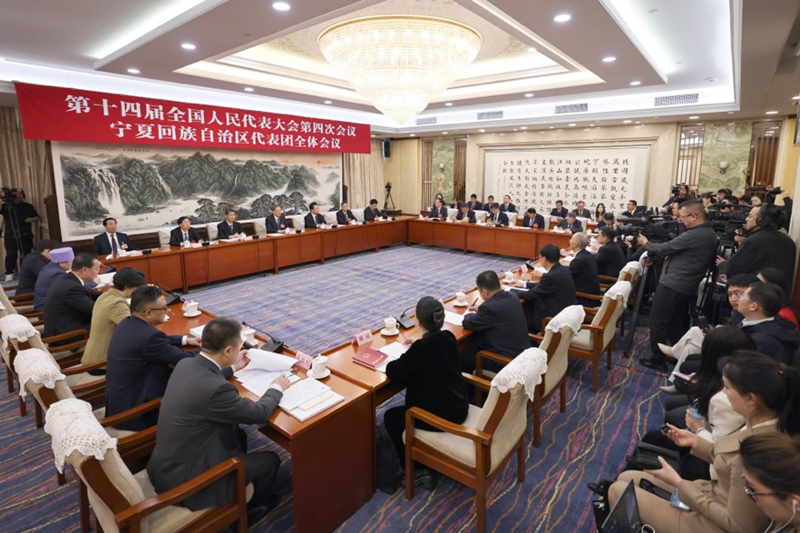
The Ningxia Hui autonomous region's NPC deputies hold deliberation as well as open day during two sessions in Beijing on March 6. [Photo provided to chinadaily.com.cn]
Large-scale population exchanges have deepened mutual understanding between the two places, Yang said.
"Working together, learning together, and building together has become part of daily life," he said.
For younger generations in Xihaigu, the impact is tangible.
Students can attend vocational schools set up under the Fujian-Ningxia partnership and find skilled jobs in coastal cities. Women relocated from remote villages are now able to work in factories and businesses close to their new homes.
"What they feel is not only personal success," Yang said. "It is the support of the country, of society, and of the Chinese nation as one family lifting them forward."

Copyright © General Office of Fujian Provincial People's Government
Website Identification Code 3500000049Registration Number: 15003084
All rights reserved. The content (including but not limited to text, photo, multimedia information, etc) published in this site belongs to fujian.gov.cn.
Without written authorization from fujian.gov.cn, such content shall not be republished or used in any form.
